Article
Debunking Common SEO Myths & Misconceptions: Myth vs Reality

LAST UPDATED:March 27, 2026
In the ever-evolving world of SEO (Search Engine Optimisation), it’s easy to fall for outdated advice or believe myths that no longer apply. Whether you’re a small business or a large enterprise, understanding SEO correctly is crucial for online success. In this article, we’ll walk you through the most common SEO myths & misunderstandings that can hurt your search rankings—and what you should focus on instead.
1. SEO is a One-Time Activity
SEO (Search Engine Optimisation) is the practice of optimising a website to improve its visibility and ranking on search engine results pages (SERPs) like Google.
Myth: Many believe SEO is something you do once and then forget about.
Reality: SEO is an ongoing process. Search engines constantly update their algorithms, competitors improve their strategies, and user behaviour changes. You need to monitor, refine, and update your SEO approach regularly to stay relevant.
In an ideal world, SEO should be a consideration right from the start of any website project, forming part of the planning stage, long before the design & development starts. However, many business owners do not have the time, resources or budget to consider SEO when launching a new site, and as a result, the optimisation of a website is a task that will be reviewed in the future
At LWDA, we do our best to design and build our websites with the best SEO practices in mind. We spend time planning the user journey to help boost enquiries, we design the interface to be engaging and visually pleasing, and we focus heavily on the technical SEO aspects during the build process. The result is a website that Google will find easy to understand and rank accordingly.
2. More Keywords = Better Ranking
Keywords are specific words or phrases that users enter into search engines when looking for information, products, or services. In SEO, keywords are strategically used in website content, meta tags, and other elements to signal to search engines what the page is about.
Myth: The more keywords you cram into your content, the higher it will rank.
Reality: Keyword stuffing is not only ineffective, but it can also hurt your ranking. Search engines have become more sophisticated and now prioritise user experience and content quality over keyword frequency. A natural, well-written piece that provides value to users will outperform a keyword-stuffed page any day.
By targeting relevant keywords, businesses can improve their visibility on search engine results pages (SERPs) and attract their target audience. Keywords can be short-tail (e.g., “shoes”) or long-tail (e.g., “best running shoes for women”), with long-tail keywords often being more specific and less competitive, making them valuable for driving targeted traffic.
When writing articles for your website, make sure that they are full of relevant content for your target audience. Truly informative content that features the right keywords will not only perform well in search engines, it will resonate with your visitors as well, helping position your company as an authority on a given subject and boost brand awareness. Just take care to balance keyword density within the natural flow of well-written unique content.
3. Meta Tags Are All You Need
Meta tags are snippets of code in a webpage’s HTML that provide information about the content of the page to search engines and website visitors. Common meta tags include the meta title and meta description, which appear in search engine results and describe the content of the page. Other types of meta tags help with indexing and control how search engines and social media platforms display your content.
Myth: Optimising meta tags alone will significantly boost your rankings.
Reality: While meta tags, such as titles and descriptions, are important for on-page SEO, they’re just one piece of the puzzle. Your content, page speed, mobile-friendliness, and backlinks are equally (if not more) important.
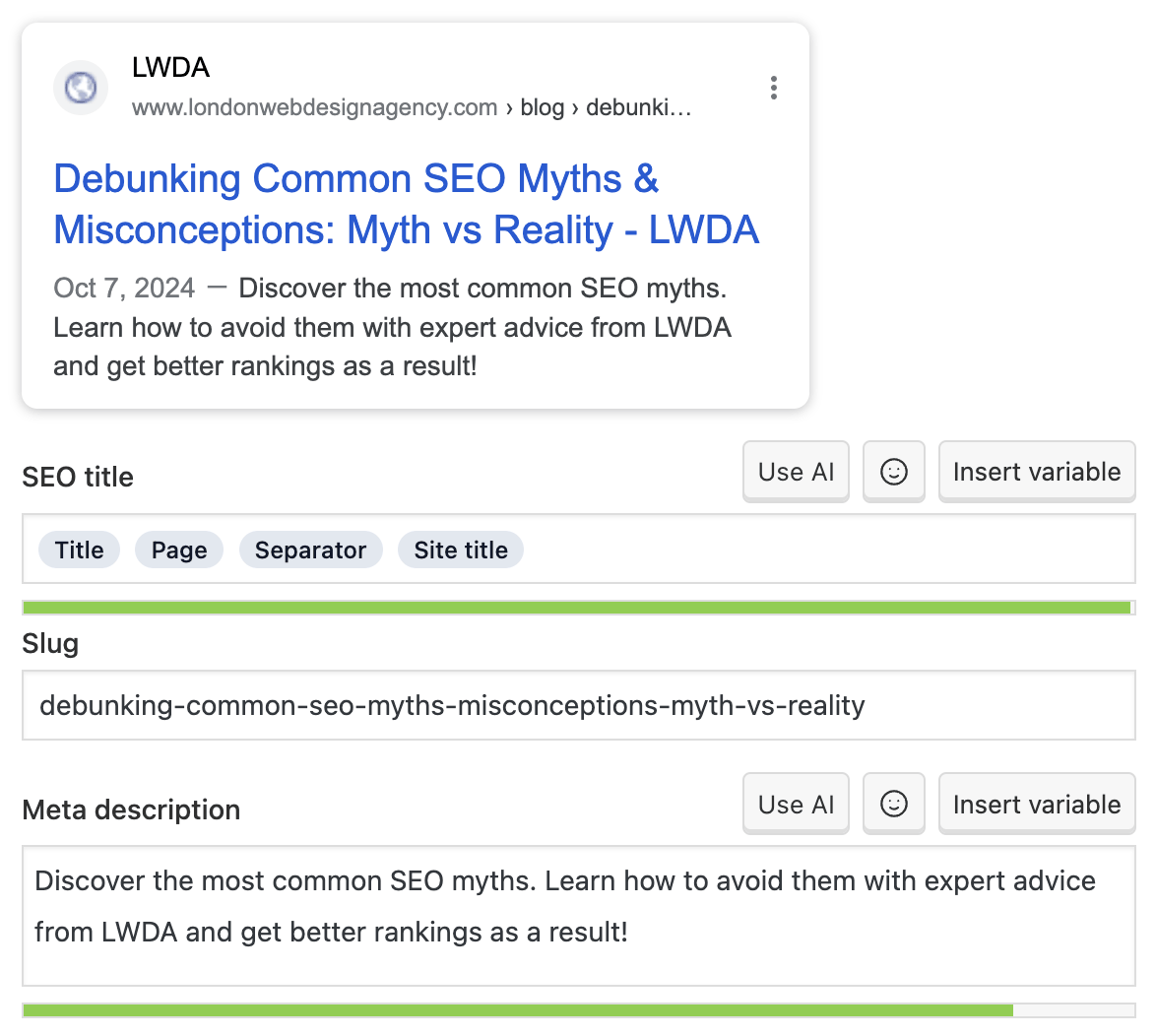
Meta tags play a crucial role in SEO by improving click-through rates and ensuring your pages are properly indexed and presented in search results, so website owners should spend time optimising these elements. Just don’t rely on them as a ranking factor.
4. Google Only Ranks New Content
Ideally, website owners should always be actively creating and publishing new valuable content for their website, but that’s not to say that old content is less valuable.
Myth: Only fresh content can rank well, so you must constantly create new material.
Reality: Google does favour updated content, but older content that remains relevant and useful can still perform well—especially if it’s kept up-to-date. Focus on content quality and relevance, rather than churning out new pieces for the sake of it.
Any good content strategy should include a regular review of old blog posts and other key web pages. In such a fast-paced world, it’s easy for information to become outdated, so reviewing old posts and updating their content with accurate information that is peppered with target keywords is a great way to increase your company’s visibility in the SERPs and gain more organic traffic.
5. Backlinks Are All That Matter
Backlinks are links from one website to another, acting as a vote of confidence or endorsement. In SEO, they are crucial for ranking, as search engines view them as indicators of a site’s authority and trustworthiness.
Myth: Building a large number of backlinks is all you need to rank higher.
Reality: Quality over quantity. Google values authoritative, relevant backlinks more than a large number of low-quality ones.
Building a strong, natural backlink profile involves earning links through valuable content, partnerships, and outreach. Effective backlink strategies are essential for boosting a site’s authority, driving organic traffic, and improving overall SEO performance, but can only work in tandem with a great content strategy.
6. Mobile Optimisation Isn’t Important
Mobile optimisation is the process of ensuring a website is user-friendly and performs well on mobile devices like smartphones and tablets. It involves adapting design elements, such as font size, navigation, and images, to fit smaller screens while maintaining fast load times.
Myth: As long as your site looks good on a desktop machine, mobile performance doesn’t matter much.
Reality: Google now uses mobile-first indexing, meaning it primarily evaluates your site based on how it performs on mobile devices.
A poor mobile experience can lead to lower rankings, and with many websites now seeing more than 50% of visitors using mobile devices, ensuring your site is mobile-friendly is non-negotiable.

Mobile optimisation – otherwise known as mobile SEO – begins with responsive design. During the earliest stages of planning, a website’s layout and design should be created with mobile devices in mind. So, if you’re in the market for a new website, make sure your web agency is showing you wireframes and designs for mobile devices as well as desktops before you start the development stage.
7. More Pages Mean Higher Rankings
When analysing the websites of potential clients, we often look at the content as well as the code and the design. We’ve seen many times, instances of websites with hundreds of pages that fail to rank well in the SERPs (Search Engine Results Pages).
Myth: Having more pages on your site will automatically boost your rankings.
Reality: It’s not about quantity but quality. A site with fewer, well-optimised pages that deliver value will always perform better than a large site with thin or duplicate content.
Whilst having more pages on your website gives you the chance to target more keywords, those web pages will fail to earn you more traffic unless the content is of sufficient quality. Focus on quality content and user engagement rather than page volume.
8. Linking Out to Other Sites is Bad
No one wants to drive visitors away from their website, so it may seem counterintuitive to include external links on your web pages. However, linking to other websites should be a part of your SEO strategy.
Myth: External links send visitors away and lose you “link juice.”
Reality: Linking to authoritative, relevant sites can improve your SEO. It signals to search engines that you’re offering valuable resources. Just make sure the external links are useful to your audience.
Users of the popular website platform WordPress will know that ‘outbound links’ is an item listed in the Analysis Results section of the popular Yoast SEO plugin. If you include at least one external link on your page, that item turns green and contributes to the overall SEO score of that page. The trick is to include truly valuable links and minimise the possibility of visitors leaving your website and not coming back.
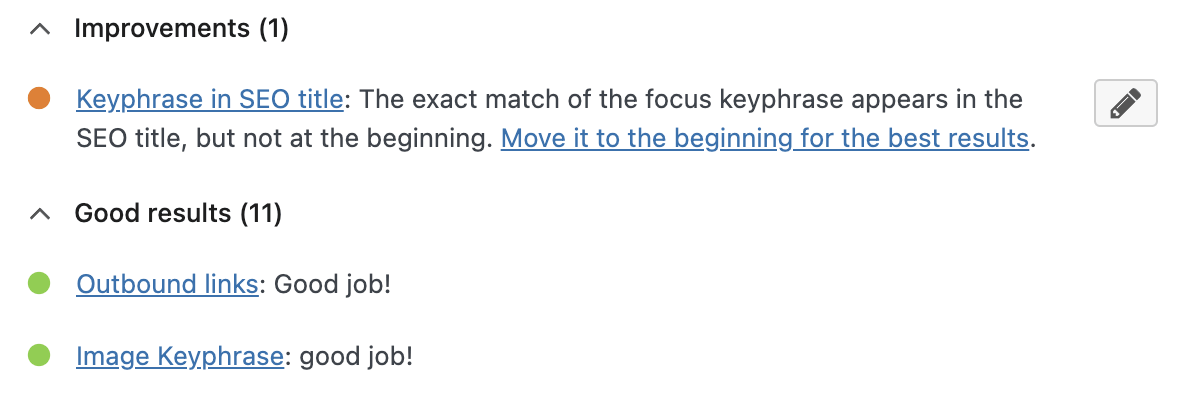
At LWDA, we tend to only include links to sources of information or third-party service providers who are not direct competitors. For example, if we were quoting some statistical information in one of our blog posts, we may wish to link to the original article featuring that research. Or, as you’ll see in this article, we’ll link to online tools or pages that include descriptions for technical terms.
9. SEO is Only About Google
It’s easy to forget that there are more search engines out there than just Google. In fact, there are 30 search engines solely dedicated to general web searching, with hundreds more for niche subjects.
Myth: SEO is synonymous with Google, so you only need to worry about ranking there.
Reality: While Google is the dominant player, don’t forget about other big platforms such as Bing, YouTube, and even Amazon, which have their own search ecosystems.
Diversifying your SEO efforts can help you capture more traffic. Depending on your business model, you may wish to consider optimising your website for voice search, so that potential customers can find your products and services via voice assistance such as Amazon Echo and Google Nest.
10. Paid Search Improves Organic Ranking
PPC (Pay-Per-Click) is a digital advertising model where advertisers pay a fee each time their ad is clicked. Commonly used in search engines like Google Ads, PPC allows businesses to bid on keywords relevant to their target audience, displaying their ads at the top of search results.
Myth: Running paid ads (PPC) on Google will help improve your organic rankings.
Reality: Paid search (PPC) and organic SEO are separate. Paying for ads won’t directly improve your organic rankings, although it can increase visibility and traffic, which may have an indirect effect on your SEO efforts over time.
Unlike organic SEO, PPC offers immediate results but requires ongoing investment. Successful PPC campaigns involve keyword research, ad creation, targeting specific audiences, and continuous monitoring to optimise performance and achieve the best return on investment (ROI).
11. Exact-Match Domains are Essential
An exact match domain (EMD) is a domain name that exactly matches a targeted keyword or search query, such as “bestshoes.com” for someone targeting the keyword “best shoes.”
Myth: Your domain must exactly match your target keyword to rank high.
Reality: While having a keyword in your domain can help, it’s not as critical as it used to be. Google now prioritises content quality, user experience, and authority over exact-match domains.
While EMDs can still be beneficial if the site offers valuable and relevant content, having a keyword-rich domain is no longer a guaranteed way to achieve high rankings. A memorable, brandable domain is often better, especially if promoted through a well-executed marketing strategy.
You may notice that our domain is an EMD. We registered the domain many years ago and built our first website soon after. Since then we have noticed how the changes in Google’s algorithms have impacted traffic numbers for the keywords London Web Design Agency, so if you’re going to believe anyone when it comes to advice regarding this point, it’s us!
12. Longer Content Always Ranks Better
As mentioned in our previous post about SEO mistakes, Yoast states that a page needs to contain at least 300 words to be deemed worthy of Google’s attention. However, an article with a word count of only 300 would not likely be particularly informative and offer very few keyword opportunities. With this in mind, it’s easy to think that when comparing articles on the same subject, the longer article will always outperform the shorter ones, But this is not necessarily the case.
Myth: The longer the content, the better it will perform in search rankings.
Reality: While long-form content can sometimes rank well, it’s the quality and relevance that matter most. Your content should be comprehensive enough to cover the topic in-depth but not padded with fluff.

We use RankIQ to optimise our content. It’s a great tool that uses AI to estimate the number of words an article needs to contain to rank highly in the SERPs.
13. Social Media Directly Boosts SEO
Social media platforms are websites in their own right, and due to the number of visitors hitting them every day, it’s easy for social profiles to outrank the websites they link to.
Myth: Social media activity will directly influence your search engine rankings.
Reality: While social media doesn’t directly impact rankings, it can generate more traffic, build brand awareness, and lead to backlinks—all of which can indirectly improve your SEO.
Using social media platforms to drive traffic to your website should be a complementary strategy and not a replacement for SEO itself. A successful social media strategy requires planning, resources (content creators), and a budget for creating content if you do not have the resources to do so within your company. You may also need to consider advertising on these platforms to build a strong social media presence.
14. SEO Results are Instant
Even today, we still find that some clients expect their new site to appear within the SERPs on the day it goes live. Likewise, any change made to the site in terms of SEO is expected to deliver immediate results, but unfortunately, this is not the case.
Myth: Once you implement SEO changes, you’ll see immediate results.
Reality: SEO is a long-term game. It can take weeks or even months to see noticeable improvements. Consistency and patience are key, but the rewards are worth the wait.

A trusted agency will be transparent concerning the time it takes for a website to rank and will never guarantee the position in the SERPs for any page. We generally see improvements within three months to any website that we audit and optimise.
15. Duplicate Content Will Always Lead to a Penalty
Duplicate content refers to identical or very similar content that appears on multiple web pages, either within the same website or across different sites.
Myth: Duplicate content will get your site penalised by Google.
Reality: Google doesn’t always penalise duplicate content unless it’s spammy or manipulative. However, duplicate content can confuse search engines, so it’s best to avoid it when possible and ensure your original content stands out.
Search engines like Google may struggle to determine which version of a page to rank, potentially diluting the page’s visibility and authority. While duplicate content doesn’t necessarily result in penalties, it can negatively impact SEO by splitting traffic and ranking potential. To manage duplicate content, site owners can use canonical tags to point search engines to the preferred version or consolidate similar content into a single page.
16. Rankings Are All That Matter
It’s no revelation that all companies want to dominate the top of the SERPs with their website, but doing so doesn’t always translate to increased business opportunities.
Myth: As long as you rank high, you don’t need to worry about anything else.
Reality: Rankings are just one part of the equation. Traffic, user engagement, and conversions are what ultimately matter. High rankings are great, but if they aren’t translating into meaningful results, it’s time to rethink your strategy.
A professional-looking website design, good user experience and user-friendly content all contribute to the feeling of a company being trustworthy, and ultimately it’s this that will help convert visitors to customers once they land on your website.
17. SEO is Dead
How we promote our brands online is forever changing. Those who have made their name using social media platforms and YouTube have very little need for a website, so for them, traditional SEO is something they don’t need to think much about. For the rest of us, we still need to take note of the changes in algorithms and the evolution of technology that influences how people search for products and services online.
Myth: With AI, voice search, and new technologies, SEO is no longer relevant.
Reality: SEO is far from dead—it’s evolving. Today’s SEO strategies focus more on user intent, voice search, and optimising websites for AI-driven algorithms. SEO has adapted to new technologies and remains a critical component of online success.
No matter if a user is searching via a keyboard, voice, or some form of AI-assisted platform, the adage that ‘content is king’ is still relevant. The technology may be changing, but the importance of high-quality content remains. At least for now.
18. You Can Outsmart Google’s Algorithms
A search algorithm is a complex set of rules and calculations used by search engines like Google to determine the relevance and ranking of web pages in response to a user’s query. These algorithms assess various factors, including keywords, content quality, website authority, user experience, and backlinks, to provide the most relevant and useful results.
Myth: There are secret tricks or shortcuts to “hack” Google’s algorithms and rank quickly.
Reality: Google’s algorithms are becoming increasingly sophisticated, focusing on user experience and content relevance. Trying to game the system with shortcuts can lead to penalties, and ultimately, it’s better to play by the rules.
Search algorithms are constantly updated and refined to improve accuracy and prevent manipulation. Understanding how these algorithms work is crucial for SEO, as it helps marketers optimise websites to align with search engine criteria, improve visibility, and achieve higher rankings on search engine results pages (SERPs).
SEO Myths & Misconceptions: Summary
In conclusion, understanding the myths and misunderstandings surrounding SEO is critical for achieving success in search engine rankings. From keyword stuffing to believing SEO is a one-time task, many of these myths can derail your efforts. Instead, focus on building a long-term strategy that emphasises high-quality content, user experience, and ongoing optimisation.
Why Choose LWDA?
Your SEO Consultant
At LWDA, we know that successful SEO requires a strategic, personalised approach. We stay on top of the latest industry trends and Google algorithm updates, ensuring our clients never fall victim to outdated SEO myths. With years of experience helping businesses of all sizes climb the search rankings, we combine data-driven strategies with creative solutions to drive real results.
Whether you’re a startup looking to increase your online presence or an established business aiming for long-term growth, we tailor our SEO services to meet your unique requirements. Let us help you turn traffic into conversions—and ensure that your SEO efforts are built for sustainable success.
Get in touch today for a free consultation, and let’s take your website to the top!
Looking for more SEO insights?
SEO Articles
We hope that our article on the top SEO myths & misunderstandings helps shed some light on why your website might not be performing as well as it could. If you’d like to get to the top of search engine rankings, you may also find the following articles useful…